THE ACA PERSPECTIVE / BUYER BEHAVIOR & TRUST

Decision confidence is not purchase authority.

Agentic commerce is not a linear journey toward autonomous purchasing. The role AI plays – and the authority a buyer grants – changes with the purchase, the customer’s confidence, and the consequences of an error.

Explore the executive guide
A DISTINCTIVE COMMERCE QUESTION
Where in your buyer’s journey does AI most influence conversion – and what must your business do to earn the next step?

The agent’s ability to perform an action is different from the customer’s willingness to authorize it. The same buyer can depend extensively on AI for research while refusing to let it choose the product or complete a purchase.

For merchants, the opportunity is broader than autonomous checkout. It includes being discovered, supporting the buyer’s decision, becoming the preferred product or service, and making the eventual transaction reliable on the customer’s terms.

TWO BUYERS. DIFFERENT PATTERNS.

The appropriate role for AI depends on the decision.

Purchase familiarity, consideration complexity, consequences of error, and confidence determine whether the buyer wants information, a recommendation, an approved action, or a bounded autonomous task.

HIGH CONSIDERATION / LAPTOP

Research deeply. Choose deliberately. Delegate narrowly.

ILLUSTRATIVE BUYER PROMPTS

“Compare these two laptops for the way I work. Explain battery trade-offs and total cost.”

“I've picked this model. Find a trusted merchant with the best delivered price and return terms. Ask me before you buy.”

AI can influence substantial parts of discovery and evaluation while the buyer retains product choice and transaction approval.

ResearchCompareChooseFind dealApprove
FAMILIAR REPEAT / REPLENISHMENT

Set the preference. Define the limits. Automate exceptions carefully.

ILLUSTRATIVE BUYER MANDATE

“Reorder this item when I’m running low, only from an approved retailer, under my price limit.”

“Ask me before substituting, increasing quantity, or exceeding my monthly budget.”

Past experience may reduce the need for fresh research, enabling selected actions under explicit constraints.

PreferenceLimitsExecuteReview exceptions

THE EXPERIENCE DESIGN QUESTION

Four permissions. No automatic promotion between them.

Good interaction design makes a delegated mandate visible. It tells the buyer what the agent knows, what it proposes, what it is preparing, and whether any purchase commitment is about to occur.

01Research

Find and explain alternatives; no purchase authority.

02Recommend

Propose a preferred option; buyer may still choose.

03Prepare

Retrieve final terms or assemble an order for approval.

04Execute

Act only when explicitly authorized and within defined limits.

These permissions represent distinct possible experiences, not maturity stages. Authority can be narrow, temporary, recurring, conditional, or revoked for future actions.

THE CONVERSION ARCHITECTURE

Get discovered. Get chosen. Get transacted.

Each commercial moment has different requirements. Success comes from matching investment to the part of the journey where the offering can earn preference or remove meaningful friction.

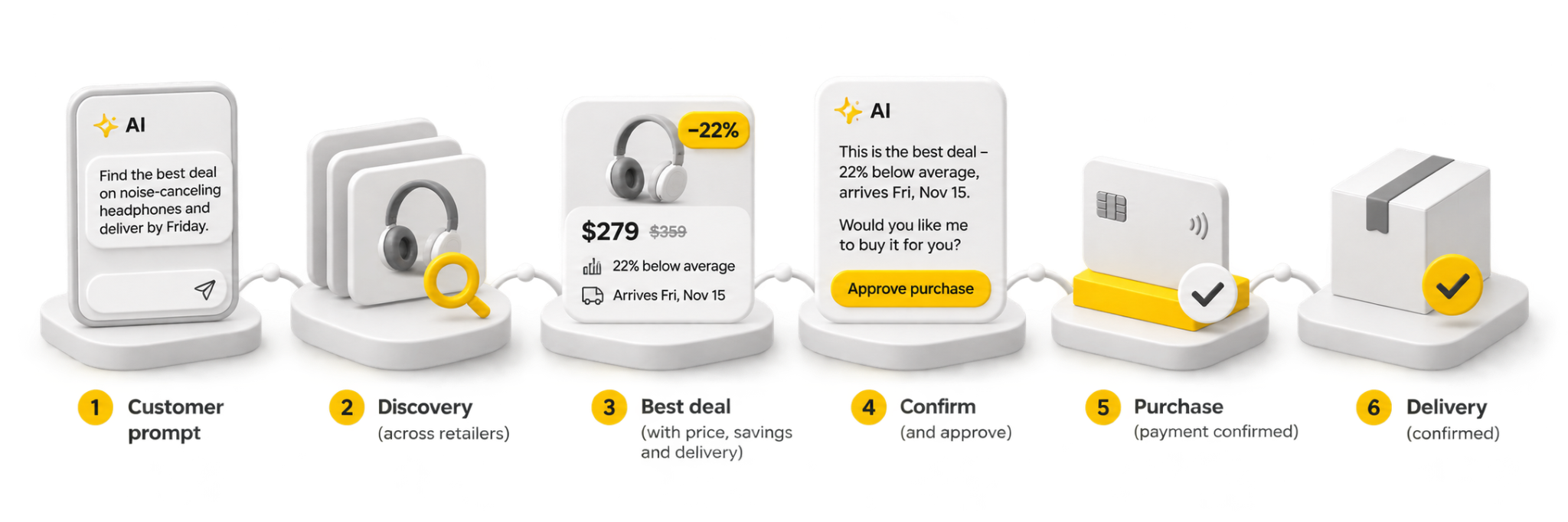
Illustrative six-stage journey: customer asks AI to find headphones, AI discovers options and identifies a deal, buyer approves purchase, then payment and delivery are confirmed.
Example customer journey – AI helps discover a deal, but the buyer explicitly approves before purchase. Prices, discounts and delivery details shown are illustrative, not live offers.
01 / DISCOVERY

Be eligible for consideration

Accurate identity, clear catalog and service information, current availability where relevant, authoritative content and contextual relevance.

02 / DECISION

Earn confidence and choice

Fit, differentiation, comparative evidence, total cost, trust, warranty, delivery and transparent commercial terms.

03 / TRANSACTION

Honor the buyer’s mandate

Approved checkout or booking flow, accurate totals, authentication, payment and risk checks, exception handling, fulfillment and support.

A LIMIT ON THE AUTONOMY NARRATIVE

Fully autonomous spend may be narrower than AI-influenced commerce.

Recurring subscriptions illustrate a familiar principle: once a buyer has evaluated the offering and agreed to recurring terms, each subsequent payment requires less active consideration. Bounded purchasing agents may extend that idea to changing prices, suppliers and delivery conditions.

But subscriptions and AI autonomy are different measures. There is no sound basis today for asserting that a specific share of total commerce will become agent-autonomous. Our strategic expectation is that familiar, repeatable purchases will be earlier candidates for bounded delegation, while AI-assisted discovery and decision support reach much more broadly.

RESEARCH SIGNAL · JANUARY 2026 SURVEY

31%of 322 U.S. consumers surveyed were willing to let AI narrow household-supply choices
11%was the highest willingness observed for letting AI make purchasing decisions, even across lower-stakes categories

Gartner survey reported May 27, 2026. These are survey responses, not observed shares of commerce spending.

Read the research source

AUTHORIZATION, ACCEPTANCE & ACCOUNTABILITY

Authority can be delegated. Responsibility must remain defined.

A buyer’s permission determines what an agent may try to do; merchant acceptance and payment controls determine whether a proposed transaction becomes a valid order. Legal responsibility depends on the authorization, parties, terms and applicable rules.

BUYER

Grants the mandate

Defines permissions, limits, approvals and whether exceptions require intervention. Delegation does not erase statutory protections.

AGENT & PLATFORM

Acts within scope

Must respect available permissions, present material terms and preserve traceability of steps taken. Platform obligations vary.

MERCHANT OF RECORD

Accepts the order

Continues to handle applicable pricing, payment, order, fulfillment, servicing and risk obligations for transactions accepted under its model.

WHERE TO INVEST

Design the journey the buyer actually wants.

For some offerings, the conversion constraint is poor visibility in AI-powered discovery. For others, it is insufficient evidence to be chosen, weak availability or deal information, or an authorization and transaction flow that creates uncertainty. The right priority is specific to the buyer, category and commercial economics.

Explore the enterprise offers

A FOCUSED CONVERSATION

Where does your business need to earn the next decision?

Let's identify the customer moment, the relevant evidence, and the commerce capability required to convert it.

Book an introduction